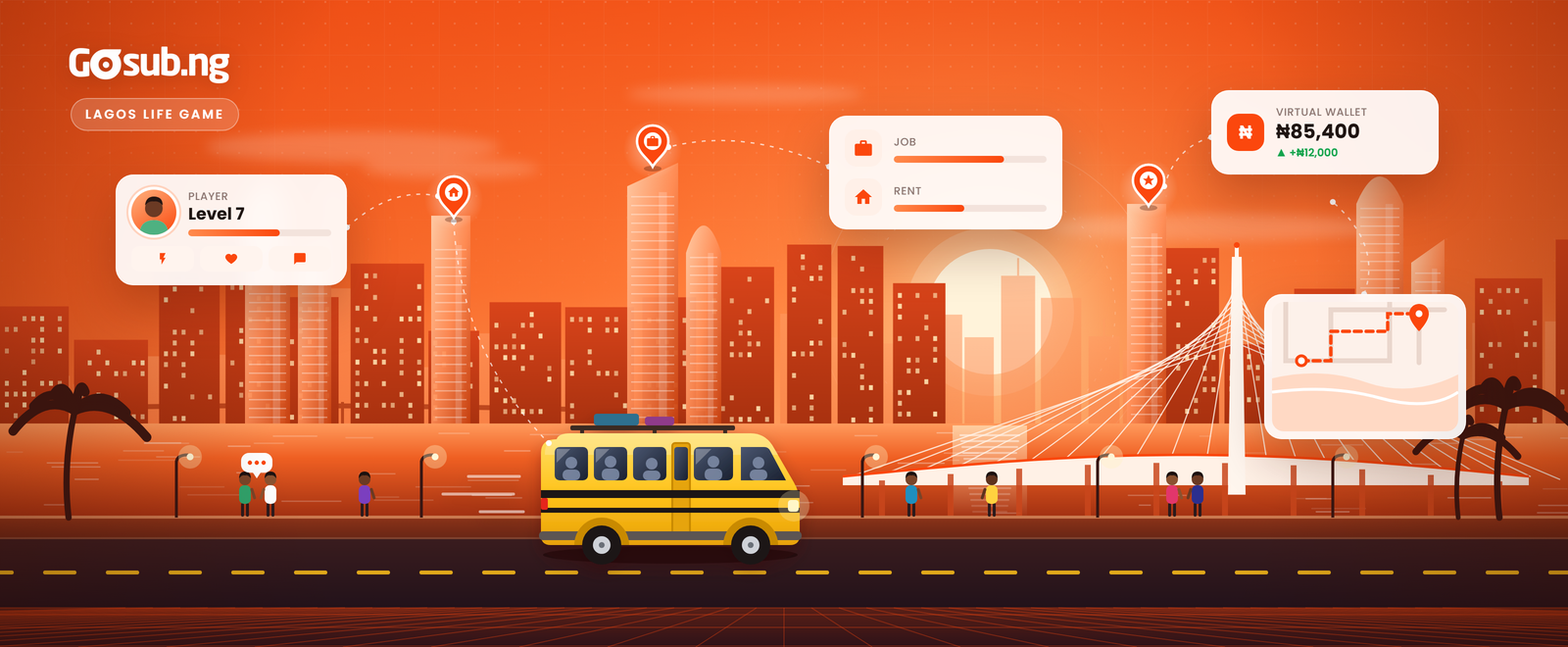
Lagos Life Game: What It Is, How to Play and Is It Free?
Last updated: 9 October 2026
Everyone Is Talking About Lagos Life. But What Exactly Is It?
If Nigerian social media has felt unusually busy lately, Lagos Life is probably one of the reasons.
The Nigerian-made browser-based life-simulation game launched on October 1, 2026, and its growth has been remarkably fast. The developer initially reported more than one million players within the first few days, before announcing that Lagos Life had crossed 2 million players on October 6 as Abuja and Port Harcourt went live. Vanguard reported the two-million-player milestone on October 7.The game's early success has since attracted wider attention. By October 9, just nine days after launch, Lagos Life had reportedly surpassed 4.7 million players, while its parent company, Vatar, announced a $500,000 angel funding round.
The numbers are impressive, but the more interesting part is what people are actually doing inside the game.
Players can create characters, get jobs, earn virtual money, pay rent, manage their character's needs, explore familiar Nigerian locations and interact with other players.
In other words, Lagos Life takes some of the everyday realities of Nigerian life, work, money, rent, socialising and even the struggle to keep yourself functioning, and turns them into gameplay.
So what exactly is Lagos Life, how do you play it, what are Nepo and Lapo, and is the game actually free?
Let's get into it.
Quick Answer: Lagos Life is a free Nigerian browser-based life-simulation game created by Shalom Rayhamen. You can play it on your phone or computer without downloading an app. Players create characters, get jobs, earn virtual money, pay rent, explore Nigerian-inspired locations and interact with other players.
What Is Lagos Life?
Lagos Life is an online life-simulation game created by Nigerian developer Shalom Rayhamen.
The concept is similar to games such as The Sims, but Lagos Life puts Nigerian life and culture at the centre of the experience.
Instead of starting in a generic fictional neighbourhood, players enter a virtual Nigerian environment filled with recognisable locations, jobs, entertainment spots, transport options and social experiences.
The game lets players build their own virtual lives by working, earning and spending in-game money, finding somewhere to live, exploring the city and interacting with other people.
The game's official disclaimer makes an important distinction: although Lagos Life is inspired by real Nigerian life, its money, prices, institutions, events and scenarios are fictionalised or simplified for entertainment.
And although the name started with Lagos, the virtual world has already expanded.
Lagos, Abuja and Port Harcourt are now part of the game.
Who Created Lagos Life?
Lagos Life was created by Nigerian developer Shalom Rayhamen, who operates under the name Eliy.
The idea for Lagos Life was partly inspired by her experience playing The Sims 3. She wanted to take the life-simulation concept and place it in an environment that felt much closer to home.
The game also drew inspiration from Lagos Run, a Nigerian browser game built around driving a danfo through Lagos.
How to Play Lagos Life
If you have been searching for how to play Lagos Life, getting started is relatively straightforward.
The game is currently accessed through its website rather than through the usual mobile app stores.
Here's how to get started:
- Go to the official Lagos Life website: lagoslife.app
- Create or access your player account.
- Enter the virtual world.
- Create your character and begin exploring.
- Use the available features to work, socialise, move around and build your virtual life.
At the moment, the game is not available as a conventional app on the Apple App Store or Google Play Store. The developer has instead made the game accessible through the website, which has helped remove one major barrier to trying it.
In other words, you do not need to start by searching your app store for “Lagos Life” and wondering which of the results is the real one.
Go to the game's official website instead.
The game is continually being updated, so features and access options can change as development continues.
What Do You Do in Lagos Life?
One of the easiest ways to understand Lagos Life is to think of it as a virtual version of everyday life, except your decisions determine how well your character survives.
You start by creating your character and entering the game world. From there, you have to figure out how to make money, where to live, how to spend your time and how to keep your character's needs under control.
Nepo Baby or Lapo Baby?
One of the funniest parts of the game's starting system is the idea of different starting circumstances.
Depending on the game's current mechanics, players can find themselves starting with very different advantages or disadvantages, including the familiar Nigerian internet jokes around being a Nepo Baby or a Lapo Baby.
The idea is simple: some players effectively begin life with more resources, while others have to hustle from the bottom.
It is a very Nigerian way of turning inequality into a game mechanic.
And once you begin, your choices matter.
Get a Job
Your character needs money, so finding work is an important part of Lagos Life. Different jobs allow you to earn money and build your virtual career.
Manage Your Energy
Your character has needs, including energy. Working and other activities use energy, so you need to balance work with rest and other activities.
Pay Your Rent
Just like real life, you need money to keep a roof over your character's head. Managing your earnings and expenses is part of the challenge.
Explore the City
When you're not working, you can explore Nigerian-inspired locations, visit entertainment spots, interact with other players and discover different activities.
Lagos Life Game Features: What Can You Actually Do?
This is where Lagos Life becomes more interesting than a simple viral game.
It is designed to feel like an entire virtual society.
Build your own virtual life
The basic idea is freedom.
You create a character and decide what kind of life you want to build.
There are jobs, money, properties, social interactions and different places to visit. The game also has government-related elements, including a governor and commissioners, giving players more than just individual characters to control or interact with.
Chat with other players
The in-game phone is another major feature.
Players can use it to communicate with other people across the country, turning the game into a social space as much as a traditional life simulator.
Imagine opening your virtual phone and seeing someone from another Nigerian city sending you a message.
Yes, even in a video game, somebody can still disturb you.
Explore Nigerian landmarks
One of Lagos Life's biggest strengths is its use of familiar Nigerian locations.
In Lagos, players can encounter places inspired by locations such as Balogun Market, Freedom Park, The Palms and Quilox.
And because the game has expanded into Abuja and Port Harcourt, the virtual world is becoming bigger and more geographically diverse.
Music and entertainment
Music is also becoming part of the game's identity.
For example, upcoming artist Banju has had his song “Over” played at the virtual Quilox nightclub.
That creates an interesting connection between the virtual world and real Nigerian music. A player may discover a song while exploring the game, while the artist gets another avenue for exposure.
For upcoming musicians, this could become an interesting part of Lagos Life's wider ecosystem.
Virtual advertising
Perhaps one of the smartest parts of Lagos Life is that the virtual city can also become advertising space.
Companies have already recognised that thousands, and eventually millions, of people are spending time inside this virtual Nigerian environment.
As a result, businesses can place advertising around the game, including virtual billboards.
It is a clever example of turning something players naturally look at into a commercial opportunity. TechPoint reported that businesses began reaching out for advertising opportunities shortly after the game's launch.
Is Lagos Life Free?
Yes, the game can be played without paying an entry fee.
However, players should understand that free to play does not necessarily mean that everything inside the game has no monetary component.
The game has systems that allow virtual currency to be purchased with real money, while the virtual money itself does not have real-world cash value or a cash-out function.
The developer has also found other ways to generate revenue, particularly through advertising opportunities within the virtual world.
That makes Lagos Life an interesting business story as well as a gaming story.
Is Lagos Life 18+?
Yes.
This is an important detail that should not be missed.
The official Lagos Life Terms of Service state that players must be 18 or older to create an account and play.
The requirement is therefore not simply a recommendation or a rating mentioned by another website. It is part of the game's own terms.
How Much Data Does Lagos Life Use?
This is one question Nigerian players understandably care about.
Unfortunately, there is no reliable official figure currently available for exactly how many MB or GB Lagos Life consumes per hour.
Because it is an online game, however, you need an active and reasonably stable internet connection to use its online features.
Your actual data consumption can vary depending on how long you play, what features you use and what else is happening on your device in the background.
So rather than promising a random figure like “Lagos Life uses exactly 100MB per hour,” it is better to monitor your data balance during your first few sessions.
Since the game runs online, keeping enough data available can save you from getting disconnected when you are in the middle of something interesting. Players can get their bundles quickly and affordably on gosub.ng so you can keep your connection topped up during your gaming sessions. .
7 Tips for Lagos Life Beginners
- Top up before you start. Check your data balance so you don't get disconnected mid-game.
- Check your Nepo or Lapo start. It tells you how urgently you need a job.
- Don't ignore energy. Work, eat and rest in balance.
- Plan for rent. Don't blow your whole balance on a Quilox night.
- Try other cities. Lagos, Abuja and Port Harcourt each have their own spots.
- Stay safe. Use only the official site, and keep personal and bank details out of chats.
- Expect changes. The game is evolving, so what works today may shift.
How Fast Did Lagos Life Grow?
Very fast.
Techpoint Africa reported that Lagos Life crossed one million players within three days of launch.
By October 6, Rayhamen announced that the game had reached 2 million players, alongside the launch of Abuja and Port Harcourt.
Vanguard subsequently reported the two-million-player milestone on October 7.
The game's own dashboard has also displayed very large numbers of concurrent players and visits. However, these figures come primarily from the game's own systems and have not been independently audited, so they are best presented as developer/game-dashboard figures rather than independently verified statistics.
That distinction matters when reporting a viral story.
Current Lagos Life stats
As of October 8, 2026:
- Reported players: More than 2 million
- Cities: Lagos, Abuja and Port Harcourt
- Platform: Browser
- Age requirement: 18+
- Entry price: Free to play
These figures can change quickly as the game continues to grow.
Why Is Lagos Life Going Viral?
The simplest answer is that Lagos Life feels Nigerian.
That sounds obvious, but it is a major part of its appeal.
Players are not entering a generic fictional city. They are seeing familiar places, familiar problems and familiar jokes turned into gameplay.
The game features locations and references including:
- Quilox
- Balogun Market
- Freedom Park
- The Palms
- Eko Hotels
- Marina Towers
- CcHub
- New Afrika Shrine
- UNILAG
- and other Nigerian-inspired locations
The result is a game that feels instantly recognisable to its target audience.
Then there is the social element.
Lagos Life allows players to interact with other people in the virtual world, making the experience feel more like entering a shared digital city than simply playing against computer-controlled characters.
That combination of familiarity + social interaction + freedom is a big reason the game has been so easy to share online.
That changes things completely.
It is less “play the game and finish the level” and more “enter the city and see what happens.”
How Shalom Rayhamen Built Lagos Life
Behind Lagos Life is Nigerian developer Shalom Rayhamen, a product builder whose experience goes beyond gaming. She specialises in building B2B products and has also worked on projects such as heyEliy.
The idea for Lagos Life came partly from Rayhamen's love of The Sims, a game she enjoyed playing. But she wanted to take the concept somewhere more familiar: a world where people could do anything, but in a setting that felt Nigerian.
That idea eventually became Lagos Life.
Rayhamen leads a small team of five, including Justina, the company's Chief Product Officer (CPO). Four members of the team are co-founders, giving the project a surprisingly lean structure considering how quickly the game has grown.
Lagos Life officially launched on October 1, 2026. What followed was far bigger than Rayhamen initially expected.
The sudden attention even attracted an offer of $100,000 to buy the game, according to Rayhamen's interview with tech creator Fisayo Fosudo. She declined, saying she values the game at $1 billion.
But perhaps the most interesting part is that Rayhamen did not necessarily build Lagos Life expecting it to become this big.
Her years of building products had already given her experience in creating, testing and improving digital products. When the game suddenly exploded, she and her team were therefore not starting from scratch, they already had the experience needed to keep improving it.
And they have been doing exactly that.
The game has expanded from its initial Lagos setting to include Abuja and Port Harcourt, while new systems and features continue to be introduced. From the virtual economy to advertising opportunities, music and new locations, Lagos Life is being developed as a living digital world rather than a game that simply stays unchanged after launch.
That may ultimately be one of the biggest reasons its story is so interesting: the viral moment happened quickly, but the experience behind the person who built it did not.
Lagos Life Hits 4.7 Million Players as Vatar Raises $500,000
Just nine days after its launch, Lagos Life had attracted more than 4.7 million players, marking a remarkable start for the Nigerian-made browser game.
On October 9, 2026, Shalom Rayhamen announced that Vatar, the parent company behind Lagos Life, had closed a $500,000 angel funding round. The announcement marked a significant milestone for the company, which launched the game on October 1.
The funding round was led by three investors: AB Hassan, Nathan Nwachuku and GB Agboola. Reports by Nigerian technology publications also put Vatar's valuation at $10 million following the company's early success.
Beyond the numbers, the announcement signals a bigger ambition for Rayhamen and her team. Lagos Life was built around the experience of everyday life in Lagos, giving players a virtual space to work, earn money, manage their characters and interact with other people. Its rapid growth has created an opportunity to develop the game further and explore new possibilities in virtual entertainment.
Rayhamen also made it clear that the company's plans extend beyond Lagos Life. In her announcement, she described Lagos as just the beginning, revealing Vatar's ambition to build entire worlds.
For a game that had been available for only nine days when the announcement was made, the milestone was significant. However, attracting millions of players is only the beginning. Vatar's next challenge will be sustaining that interest, improving the gaming experience and turning its early momentum into long-term growth.
Lagos Life Game Review: Challenges Facing Lagos Life
Lagos Life has had an impressive launch, but its rapid growth also comes with a few challenges that could shape how the game develops.
The in-game economy needs more depth
One recurring criticism is that making money can feel too easy. If players become financially comfortable too quickly, earning money may lose some of its purpose. More expensive goals, clearer differences between economic levels and greater financial challenges could make progression more meaningful. Gaming creator Manja Lee has also raised similar concerns about the game's difficulty and economy.
Can it keep players interested?
Going viral can attract millions of players, but keeping them engaged is a different challenge. Lagos Life may need a steady stream of new activities, events, storylines, jobs and goals to give players reasons to return after the initial excitement fades.
Growth brings new challenges
As the player base grows, the developers also have to keep the game stable while maintaining a fair virtual economy. An exploit that allowed some players to accumulate large amounts of virtual money showed how quickly the game's economy can be affected. Meanwhile, the social side of Lagos Life could benefit from more community events, competitions and player-driven activities as the game continues to expand.
Overall, Lagos Life's biggest challenge may no longer be attracting players, it has already shown that it can do that exceptionally well. The real test will be turning its viral launch into a game that people continue playing long after the initial hype fades.
Final Thoughts
The Lagos Life game is interesting for more than just its viral numbers.
It is a Nigerian-made attempt to take something familiar, the chaos, ambition, entertainment, money problems, social life and everyday experiences associated with Nigerian cities, and turn them into an interactive world.
Its rapid growth may have surprised even its creator, but Rayhamen's years of building products, her experience with B2B technology and her understanding of what people want from digital experiences clearly gave her useful preparation for the moment.
And now, Lagos Life is becoming more than Lagos.
With Abuja and Port Harcourt already joining the virtual world, the experiment is getting bigger by the day.
Whether you are playing to become governor, exploring Quilox, chatting with strangers, checking out the virtual streets or simply trying to understand why everybody on X suddenly has a second Nigerian life, one thing is clear:
Lagos Life has turned the internet into another city, and Nigerians have already moved in.
If you plan to spend time in that virtual city, remember that your real-life internet connection still has to keep up. When you need a data bundle for your next session, gosub.ng can help you stay connected without turning your gaming session into another episode of “network don go.”
Frequently Asked Questions (FAQs)
What is Lagos Life?
Who created Lagos Life?
When was Lagos Life launched?
Can I withdraw money from Lagos Life?
Is Lagos Life free?
Where can I play Lagos Life?
How much data does Lagos Life use?
📚 Related Articles


Author: Naomi Igbinosa
Customer Service Representative
